

Cashmere Socks: The Quiet Luxury Every 2026 Line Sheet Needs
Socks used to be the item a wholesale buyer added at the end of a meeting, almost as an afterthought. In 2026 they are increasingly the first sample a retailer asks to see — because cashmere socks are the lowest-risk way for a customer to try a cashmere brand, and the highest-frequency way for that customer to come back. This guide sets out what the market is doing, how the fibre behaves on a foot rather than a shoulder, the construction specs that separate a two-season sock from a two-week sock, and how to build an assortment that reorders. The numbers are modest in absolute size and unusually consistent in direction. The global cashmere socks market was valued at USD 461 million in 2025 and is projected to reach USD 837 million by 2034, a compound annual growth rate of 6.8% [source: Dataintelo, Cashmere Socks Market 2025–2034]. An independent forecast puts the 2026 figure at USD 312.6 million growing to USD 565.11 million by 2035 — the same 6.8% CAGR on a narrower base definition [source: MarkWide Research, 2026]. Three structural details matter more to a buyer than the headline growth rate: On the supply side, roughly 70% of the world's raw cashmere comes from pastoral regions in China and Mongolia, and raw fibre prices have historically swung 15–20% year on year with pasture and herd conditions [source: Data Insights Market, 2026]. That volatility is the strongest argument for buying socks from a supplier who controls yarn rather than one who buys it in. Cashmere is the fine downy undercoat of the cashmere goat, and its commercial value rests on two measurements: fibre fineness of roughly 12–19 microns and a staple length of 34–40 mm, which together deliver the insulation and softness that define the premium comfort segment [source: Data Insights Market, 2026]. Grade A fibre sits at the fine end of that range, and it is the grade that keeps a sock comfortable against skin that is warm and slightly damp. Three fibre properties explain why cashmere performs so well in hosiery: This is where a sock programme is won or lost. A sock yarn is engineered for abrasion in a way a sweater yarn never has to be, because the foot moves inside a shoe thousands of times a day. There are three commercially proven constructions [source: Consinee Cashmere Yarn, Sock Yarn Construction]: Alongside the yarn, four finishing details do most of the work in the hand and in the wash: A sock range fails when it is built as a colour exercise instead of a use-case exercise. Four blocks cover almost every retail brief, and each one answers a different customer question: For buyers who want the range to arrive pre-built rather than designed from scratch, Ewsca carries a dedicated cashmere socks collection, alongside the individual styles — a seamless ladies' 100% cashmere sock and a second seamless construction developed for autumn/winter programmes. Sock sizing is the least glamorous part of the brief and the most common source of returns. Three practical rules: Cashmere socks live or die on care. The instructions that matter are consistent across the category and simple to print on a card or a tag: Care guidance is not just customer service; it is a merchandising asset. A brand that ships a wash bag and a care card with a cashmere sock typically sees fewer complaints about pilling and shrinkage, and a customer who keeps a sock looking new for longer is a customer who buys the second and third pair. In a category where repeat purchase intervals have shortened dramatically among urban professional buyers [source: MarkWide Research, 2026], that matters more than any single seasonal colour. Ewsca has produced cashmere knitwear for more than two decades, and socks run on the same yarn sourcing and finishing discipline as our sweaters. Our current sock styles are computer-knitted in 100% cashmere at 12 gauge with a seamless construction, built for the autumn/winter season, with an MOQ of 100 pairs per style and colour for stock items. We run two development paths, matching the way most buyers actually plan a season: Q1. Should I specify 100% cashmere or a blend? Q2. What fibre spec should appear in the purchase order? Q3. Which sock length sells best? Q4. How should customers wash cashmere socks? Q5. Can socks be coordinated with an existing knitwear range?1. Why Cashmere Socks Are the Quiet Growth Category of 2026
2. What the Fibre Does Differently on a Foot
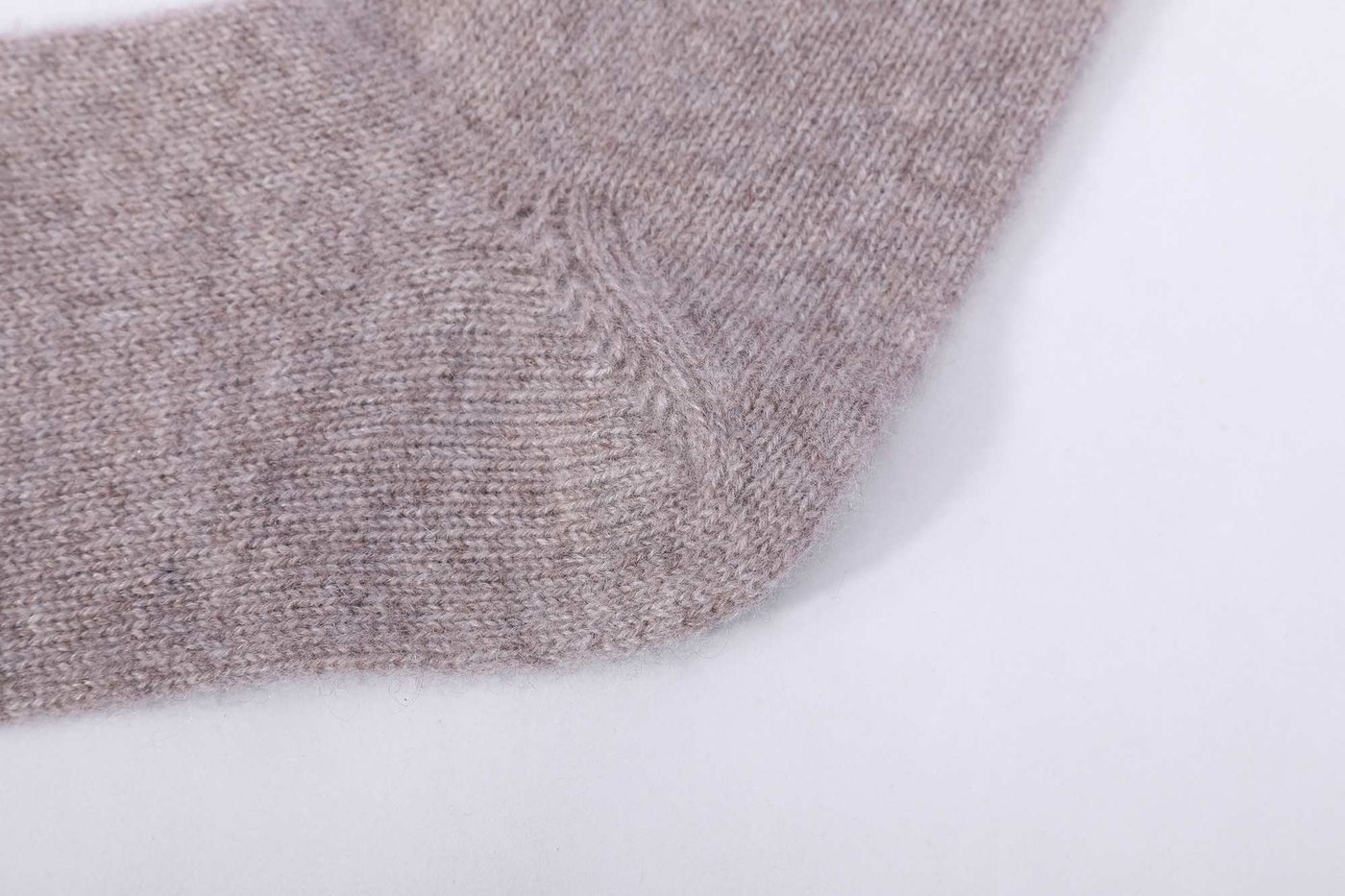
3. The Construction Specs That Decide Whether a Sock Lasts
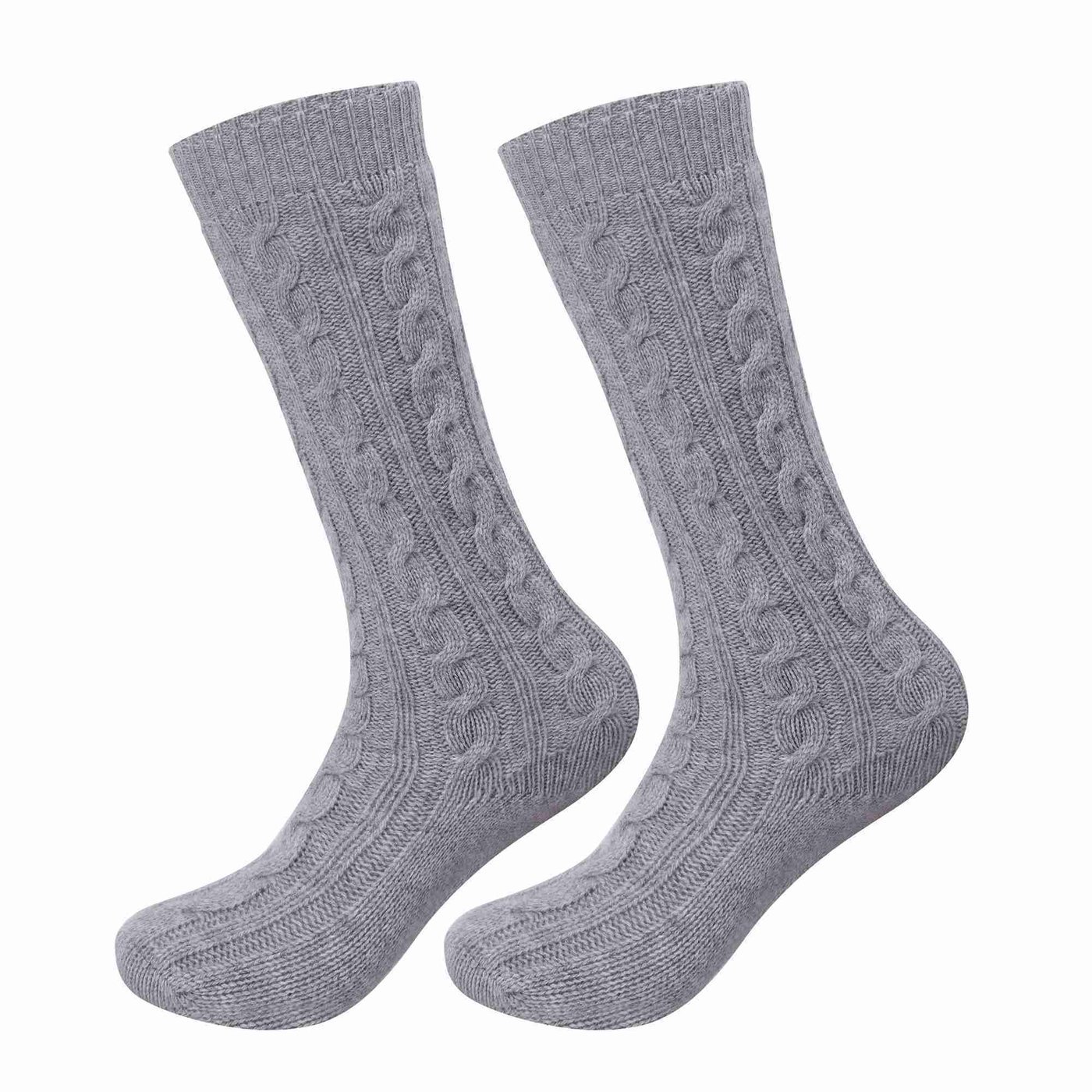
Construction Yarn / gauge Abrasion performance Best use in a 2026 range Core-spun 80/20 2/36 Nm, mid gauge ~50–70 Martindale cycles Volume winter crew socks with a pure cashmere hand Intimate blend 70/30 2/48–2/60 Nm, fine gauge ~70–100 Martindale cycles Dress and trouser socks for professional wear Zoned intarsia Mixed plies, 96–200 needles Highest, reinforced zones only Hero styles and long-life premium tiers Heavy casual knit 7 GG, wide rib Depends on blend ratio Lounge, homewear and gift-set pieces 4. Building the 2026 Sock Assortment
5. Sizing, Fit, and the One-Size Question
6. Care, Wear Life, and the Reorder Signal
7. How Ewsca Builds a Wholesale Sock Program
8. Wholesale Cashmere Socks FAQ
It depends on the use case. A 100% cashmere sock is the softest option and works well for lounge and gift styles. For socks worn inside shoes daily, a reinforced blend — commonly 85/15 or 80/20 cashmere–nylon, or a zoned construction with tougher heel and toe plies — lasts substantially longer without a noticeable difference in hand.
Origin, fibre diameter, and staple length at minimum. Fine-grade cashmere sits at roughly 12–19 microns with a 34–40 mm staple; ask for the numbers in writing, not as adjectives, so a reorder can be checked against the approved sample.
Crew length holds the largest share of the global cashmere sock market at 38.5%, ahead of ankle and knee-high constructions. A practical range leads with crew, adds a fine-gauge dress or trouser sock, and uses ankle or knee-high styles as the seasonal variation.
Inside out, at 30 °C or below, with a neutral or cashmere-safe detergent, ideally in a laundry bag or by hand. Rinse without wringing, reshape, and dry flat away from direct heat and sunlight. Never tumble dry.
Yes, and it is the most efficient way to extend a line. Matching an existing yarn count and colour story lets a sock sit alongside scarves, slippers, lounge pants, and sweaters as a single collection — which is how gift sets and accessory capsules are usually built.