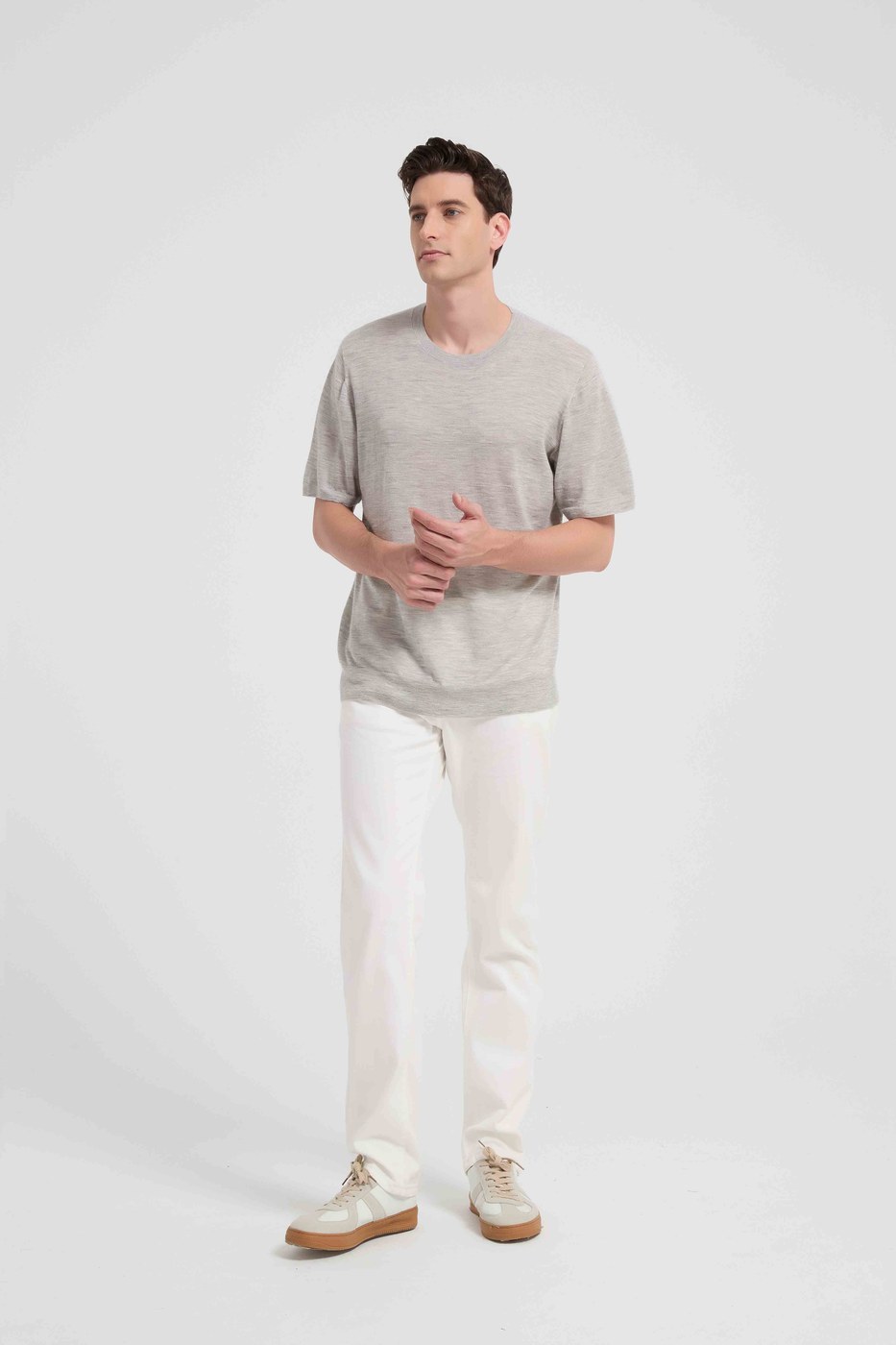
Cashmere T-Shirt Supplier Playbook: Worsted Knits for the Spring 2027 Buy
Oct 15,2026
A cashmere programme used to be a winter programme, and the short-sleeve piece was the experiment at the edge of it. That has changed. Buyers who spent years building an autumn-winter knit business are now extending the same yarn, the same colour card and the same supplier relationship into spring, because the garment underneath them in the range is no longer holding its ground.
The short-sleeve cashmere knit is the piece that carries that extension, and it is also the piece most often specified loosely. A fine knit has nowhere to hide: a stretched neckline, a visible seam, a yarn that pills by the third wear or a hand feel that disappears after one wash cannot be covered by pattern or by a heavier stitch. This guide sets out what a cashmere T-shirt supplier should be asked to put in writing, from gauge and yarn count to neckline construction and the calendar that decides whether the range lands in March or misses the window entirely.
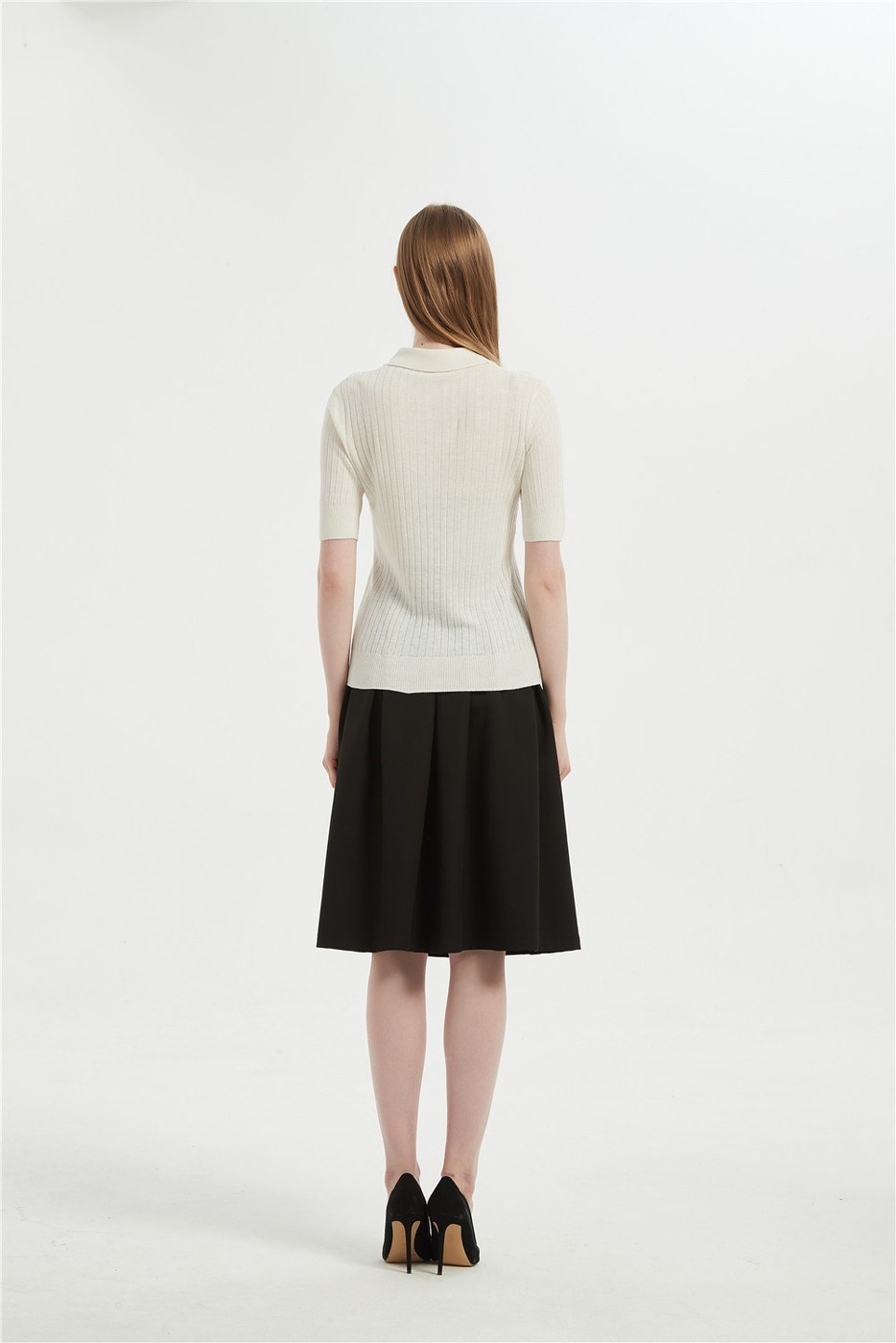
The reverse face is where a fine-gauge knit is judged first. Back neckline, shoulder linking and side seams are all visible at once on a light knit, which is why these three lines belong on the sample comment sheet rather than in a general note.
1. Why the Short-Sleeve Knit Became a Programme, Not a Test
Three commercial facts explain the shift, and none of them is about a trend cycle.
The garment beneath it plateaued. Cotton jersey has become a crowded category that competes on graphics at one end and on being undifferentiated at the other. Brands looking for an upgrade tier their customer will actually pay for have moved into knit, and the movement is visible in what factories are quoting: buyers who built their volume on autumn-winter knit are now asking those same suppliers to cover the spring half of the calendar, and the knit polo is taking share from the cotton tee inside elevated ranges. The spring summer 2027 light-knit direction forecast describes the same gap — between a crowded jersey tee and a seasonally specific woven shirt — as the space in which the light-knit category is growing.
The gauge range makes it a real product, not a thinned sweater. Fine-gauge knitting is what separates spring knit from winter knit. In practice most spring-summer programmes sit at 12GG and 14GG, which is fine enough to read as warm-weather product rather than as a lightened winter sweater while remaining robust enough for a commercial manufacturing calendar; 18GG belongs to pieces intended to sit under a jacket without bulk, and that is the band where a tee or a shell vest makes sense. Above 18GG the fabric starts to behave like a woven, the knitting operation narrows and the minimum quantity rises.
It extends the selling season at both ends. A short-sleeve cashmere knit sells in the transitional retail windows on either side of summer, not only at the height of it, and knitwear as a whole translates easily from city to resort and into more than one season. Retailers act on this: polo shops and airport boutiques raise their knit allocations for spring collections in anticipation of travel shoppers, as the Milan buying notes in this spring 2027 retail read describe. A tee that layers under a jacket in April and wears alone in July is a different commercial object from a summer-only garment.
The one caveat is calendar discipline rather than construction. Spring knit uses less yarn per piece than a winter knit, but the season is shorter and the sell-through window narrower, which means a late delivery has no second chance. Getting the product on the floor on time matters more in this category than trimming anything else out of the programme, and it is the reason the sampling calendar in section seven is worth agreeing before the first sample is requested.
2. Tee, Polo, Tank and Shell: Naming the Short-Sleeve Formats
Most of the friction in this category starts as a vocabulary problem. Four different garments are all called a cashmere T-shirt in the same email thread, and each one has a different knitting operation, a different yarn consumption and a different retail placement. Settle the format before the sample request and a development round disappears.
Format
Typical construction
Buying note
Crew-neck tee
12GG to 14GG plain knit, set-in or short raglan sleeve, ribbed neckline and hems
The volume piece and the hand-feel carrier of the range. Judge it on neckline recovery after washing, because that is what the customer feels first.
Knit polo
Fine gauge with a self-fabric or knitted placket, ribbed collar, two to three buttons
The format taking share from the woven and jersey polo. Specify placket construction and button quality explicitly; a soft placket on a fine knit is the usual failure point.
Tank top
Single jersey or rib, narrow shoulder strap, deep or scooped armhole
The layering piece of the range. Armhole trim executed as self-fabric rather than a bound edge is what keeps the shape on a fine knit.
Sleeveless shell or vest
14GG to 18GG, higher or collared neckline, straight or shaped hem
The piece designed to go under a jacket. Confirm the armhole depth against the jacket it will be worn beneath, not against a measurement chart.
Long-sleeve tee
Lightweight full-length sleeve, ribbed cuff, same body construction as the short-sleeve piece
The autumn bridge inside the same programme. Shares yarn and colour with the short-sleeve version, which is what makes one dye lot serve two deliveries.
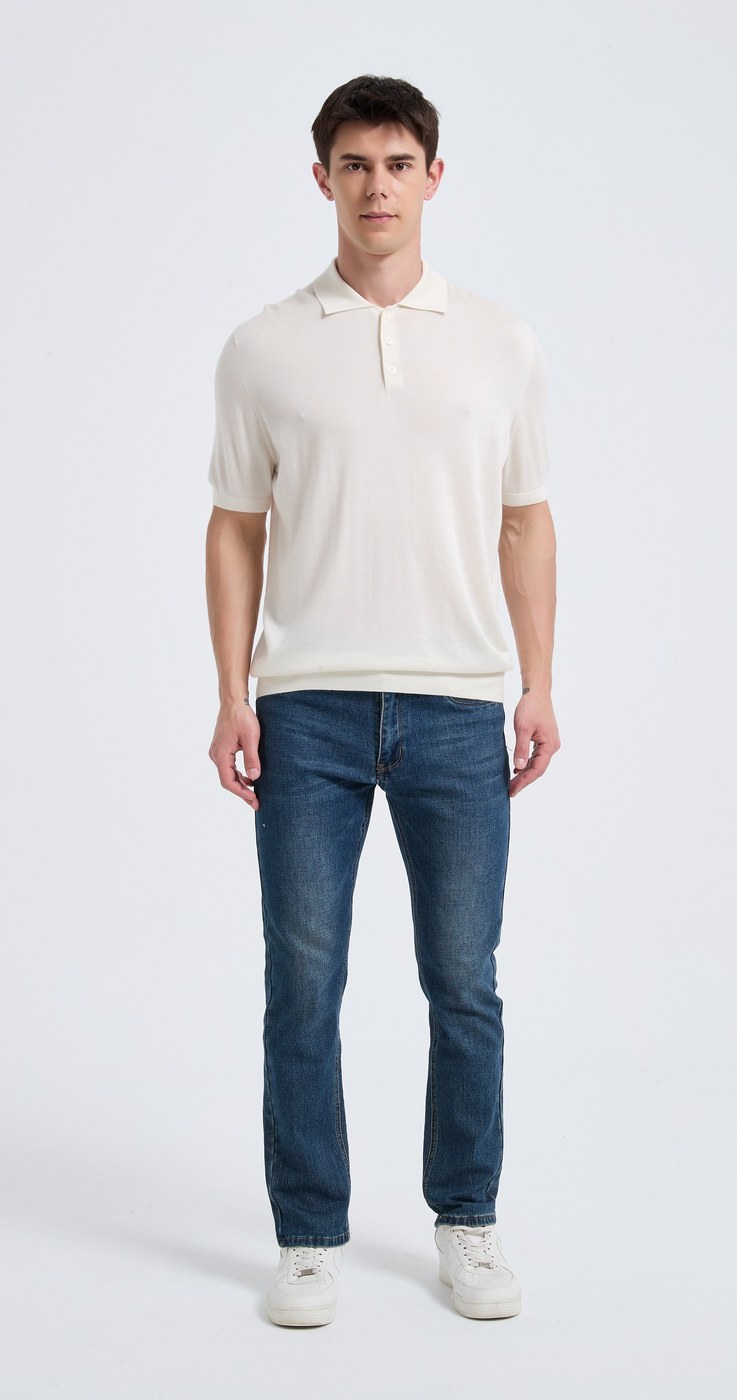
The knit polo in its retail form: fine gauge, self-fabric placket, ribbed collar and cuff. The collar is where a light knit is most often underbuilt, so specify its structure and its recovery, not only its shape.
3. The Specification Sheet a Cashmere T-Shirt Supplier Should Hand You First
A tee specification is shorter than a sweater specification but the lines matter more, because the tolerance on a fine knit is narrower. Ask for these ten lines in writing on the sample submission and hold them through every reorder.
Specification line
What it should state
Fibre composition
Every fibre present, with a percentage for each. "Cashmere blend" is not a specification, and the order of fibres on the care and content label has rules attached to it.
Fibre fineness
Mean micron value for the batch, measured rather than quoted from a yarn brochure. Cashmere for a next-to-skin fine knit typically sits in the mid to high teens; the reference data on yarn counts and fineness in this cashmere yarn specification shows how the two are recorded together.
Yarn count and ply
Count in Nm and the ply, for example 2/48 Nm or 2/60 Nm, plus whether the yarn is worsted spun or woollen spun. This single line decides surface, sheen and pilling behaviour more than any other.
Gauge
The machine gauge in GG and the stitch structure: plain, rib, mesh, pointelle or a mixed structure. A gauge figure without a stitch name is only half a specification.
Finished weight
Weight per square metre or per piece, measured on the finished and washed garment, with a stated tolerance. It is the most useful single control at reorder.
Finished measurements
Chest, body length, sleeve length or armhole depth as applicable, with the measuring method named and the tolerance stated. For a light knit, the post-wash measurement is the one to hold.
Neckline construction
How the neckline is finished — ribbed trim with a stated depth and width, self-fabric binding, or a linked or rolled edge — and the neckline recovery expected after three washes.
Seams and shoulders
Fully linked shoulders, flat-lock or overlooked seams, and the seam allowance. On a fine knit every one of these is visible through the fabric surface when the piece is worn.
Wash and shrinkage behaviour
The care route the garment is engineered for, and the measured dimensional change after one wash cycle carried out exactly as the care label instructs. Panel tension and size tolerance controls are how a factory holds this across a bulk lot.
Certification and labelling
The certification scope and the production site it names, plus the fibre content wording and country of origin that will appear on your label.
One habit worth building: measure the approved sample before washing, wash it exactly as the label instructs, dry it the way the label instructs, then measure it again and photograph it beside the unwashed piece in daylight. A light knit moves further than a heavy one, and whatever moved on that sample will move on the whole delivery. This is the test that catches a neckline that will open up and a body that will drop, both of which are invisible on a flat sample photo.
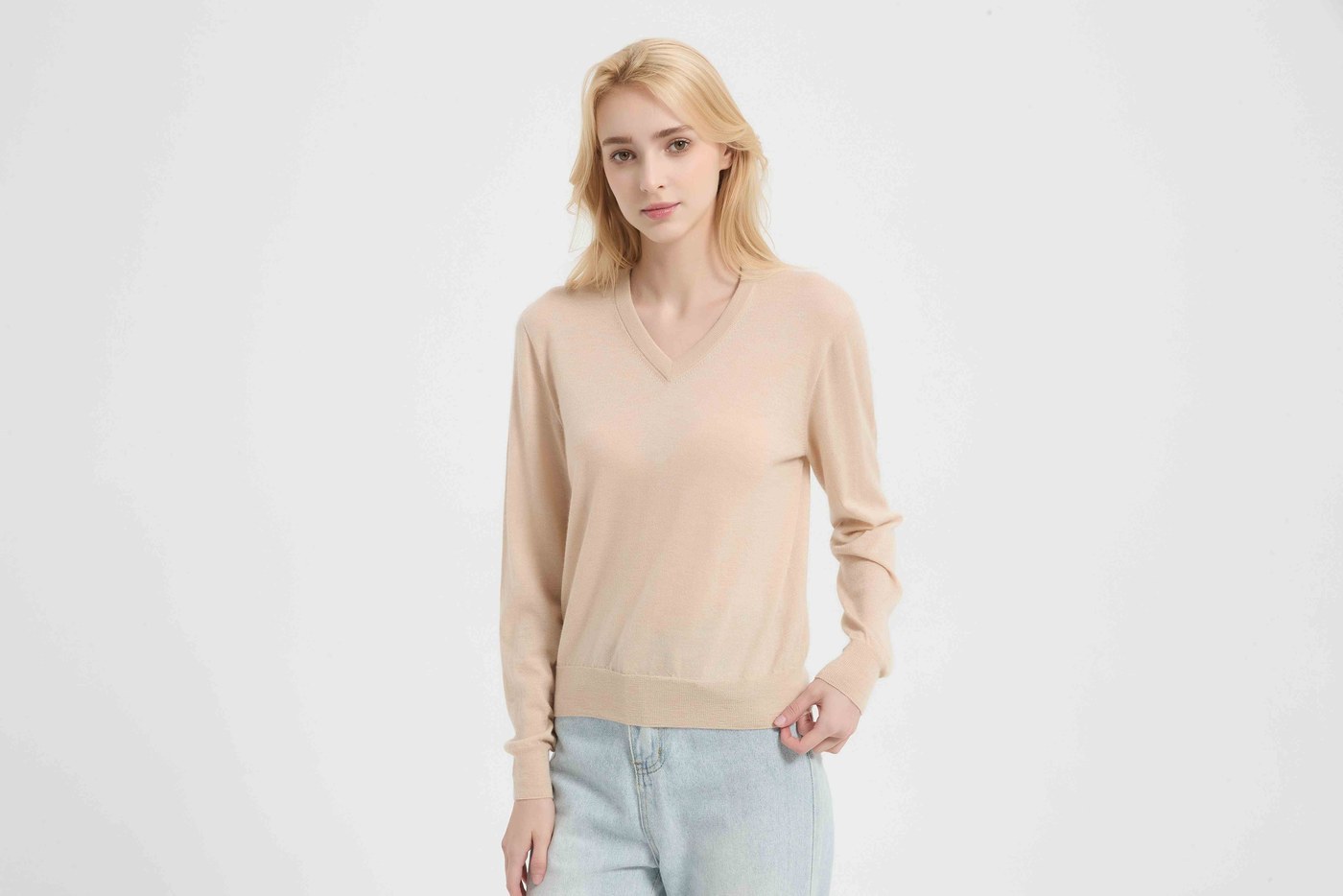
A crew neckline on a fine-gauge knit. Rib depth, rib width and the join at the shoulder all sit within a few centimetres, which is why the neckline line on the specification sheet carries more weight here than on a heavy sweater.
4. Blend Routes: Worsted Baby Cashmere, Silk and Cotton
The fibre decision on a fine knit is a decision about surface and behaviour, not only about content. Three routes cover most of the category.
100% worsted cashmere
Worsted spinning combs the short fibres out of the yarn before it is twisted, which leaves a cleaner, smoother yarn with a faint natural sheen and a much lower tendency to pill than a woollen-spun equivalent. On a fine knit that difference is visible at arm's length: the surface reads even rather than slightly cloudy, and the stitch definition stays crisp because there is less stray fibre to blur it. A 100% worsted baby cashmere knit is the clearest hand-feel statement in a spring range and the easiest piece to justify carrying at the top of it — our women's worsted baby cashmere knitted shirt and the matching men's crew-neck version are built on that route.
Cashmere and silk
Silk is what turns a knit into a drape. It adds lustre, lets the fabric fall close to the body without clinging, and gives the piece a faint coolness against the skin that reads as spring rather than winter. The usual commercial split is cashmere-forward with silk in the minority, which keeps the fibre story intact while changing how the garment hangs, and the finish makes the fabric comfortable in warmer conditions than 100% cashmere would be. Two constructions that show the route in retail form are our silk cashmere T-shirt and our men's short-sleeve worsted silk cashmere polo shirt; a retail-facing example of how the blend is merchandised for a spring and summer range is set out in the men's cashmere tops range of a specialist knitwear label.
Cashmere and cotton
Cotton brings body, a drier hand and a crisper surface, which suits a structured tee or a polo whose placket has to hold a shape. The blend also moves the care conversation: a cotton-rich yarn tolerates a more forgiving wash route, which matters for a piece the customer wears weekly. The trade-off is that cotton reduces the softness that sells cashmere in the first place, so a cotton-forward blend works best in the volume tier of the range and in colourways where the surface rather than the hand is the story.
Whatever the route, the fine-gauge direction for the season pushes in the same direction. Spring and summer stitch development is concentrating on lightness, transparency and refined surface variety — punched vertical structures, fine-gauge openworks, all-over fine cables and lace-like stitches — and the stitch reports behind it, such as this fine-gauged stitch direction for spring summer 2027, are worth reading alongside the yarn decision. Structure is where a light knit earns its place in a range, because it is the only differentiator the customer can see and feel at the same time.
5. Necklines, Trims and Seams: Where a Light Knit Is Judged
On a heavy sweater the customer notices the colour and the hand feel. On a fine knit the customer notices the edge. Four construction lines do most of the work.
The neckline. Ribbed trim with a stated depth and width is the most reliable route on a fine knit, because the rib is what pulls the neckline back into shape after the piece is pulled over the head. Self-fabric binding gives a cleaner, flatter finish that suits a shell or a minimal tee, but it has less recovery and has to be specified with a slightly firmer tension. Whichever is chosen, the neckline recovery after three washes is the number to hold.
Sleeve and hem finishing. On short sleeves and hems, rib or a doubled self-fabric turn keeps a fine knit from rolling and from waving at the edge. A raw cut edge, or a turn that has been applied under uneven tension, will read as an unfinished garment and will be noticed on the hanger before the fibre is.
Shoulder joining and side seams. Fully linked shoulders sit flat and follow the body line; on a light knit an overlooked shoulder can produce a ridge that shows through the surface. Flat-lock or a specified flat seam on the side is the same argument: on 14GG the seam allowance is a visible part of the garment rather than a hidden detail.
Shoulder and armhole stability. The shoulder and armhole are where a fine knit loses its shape first, and a small tape or a defined seam allowance is what prevents the piece from growing across the shoulder as it is worn. It is a low-visibility line on the sheet and the decisive one two seasons later.
The neckline spread test: lay the sample flat, measure the neckline width, then put the piece on a form, remove it, and measure again. Repeat twice more. A neckline that has grown by the third wearing is a construction problem rather than a wear problem, and it will be reported as a quality complaint by every customer in the delivery.
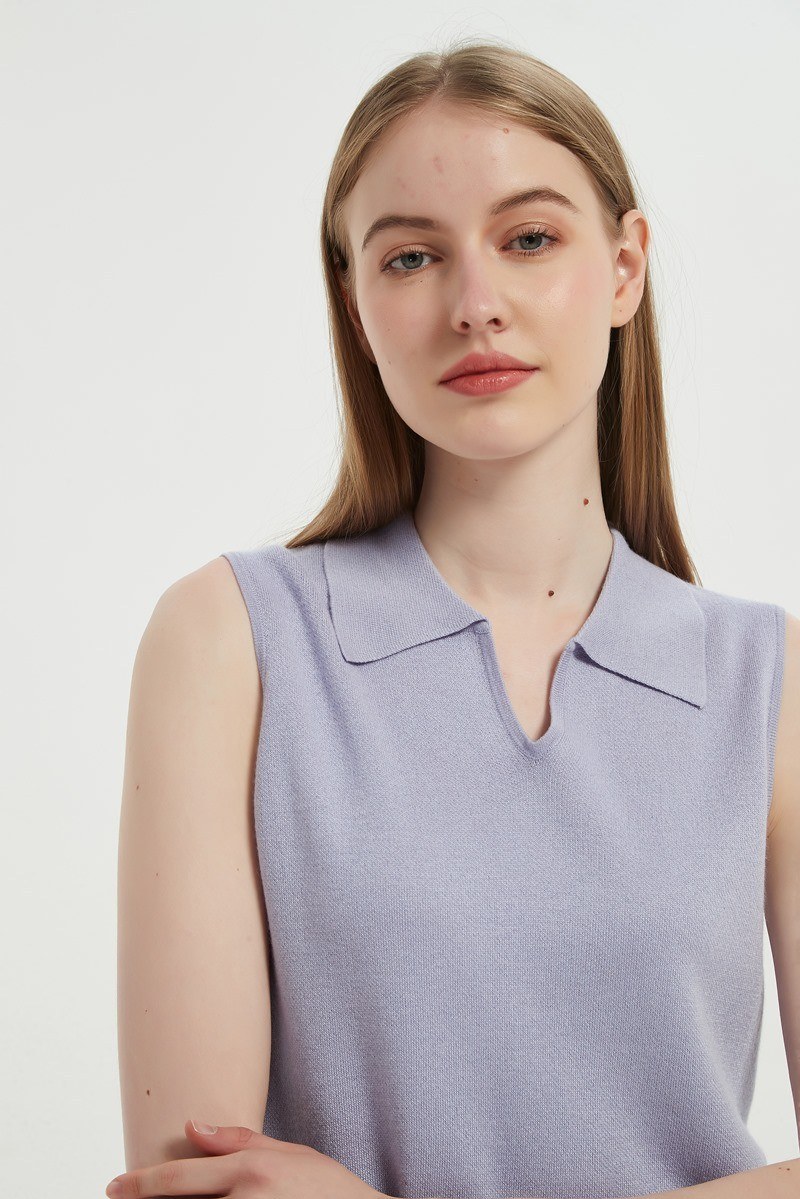
A collar point on a sleeveless fine knit. Any collar or placket on a light knit has to be knitted or cut with a firmer hand than the body, otherwise it collapses within a season of wear.
6. The Colour Card for Spring 2027
A spring knit range is bought as a colour story, and a fine knit shows colour differently from a heavy one because there is less surface shading to soften a shade. Pale, low-saturation neutrals read cleanly at 12GG and 14GG, while deep shades gain depth without appearing heavy. The seasonal reads point the same way: trans-seasonal pale tones such as soft pink are being carried across spring and autumn rather than treated as a single-season colour, as this colour report on trans-seasonal pale pink sets out, and the knit layer is where those tones are easiest to sell because a light knit carries a pale shade without looking fragile.
The practical structure that works across a range is a three-part card:
A warm neutral core. Oatmeal, chalk, pale camel and stone. These carry the volume, photograph evenly, and are the shades a buyer can reorder with confidence because they do not date within a season.
One or two deep anchors. Deep navy, chocolate or a warm charcoal. A single dark shade held consistently across the tee, the polo and the vest is what makes the short-sleeve pieces read as one collection rather than as separate garments. The knit layer's role as a bridge between tailored pieces and lighter clothing is part of what has driven its return, as the reporting on the cashmere layer in premium ranges describes.
One or two seasonal accents. A single soft accent colour, whether a pale pink, a muted blue or a low-saturation green, merchandised as the front-of-range story. Two accents is the practical maximum, because a third dilutes the card and complicates the dye minimums for every shade in it.
Colour consistency across repeat orders is a lot-control question rather than a design question, and it is worth agreeing the retained-golden-sample routine with the supplier before the first bulk delivery rather than after the second.
A warm neutral in a fine gauge. On a smooth worsted surface the shade reads evenly across the whole garment, which is what makes a light knit the easiest place in a range to hold a pale neutral consistently.
7. Washable Finishing, Certification and the Sampling Calendar
A short-sleeve knit is worn against the skin and washed often, so the finishing route matters as much as the fibre. Machine-washable treatment is now a normal part of a fine-knit brief rather than an upgrade, and it changes the specification: the yarn is engineered for the wash route, panel tension is controlled so the piece keeps its measurements, and the care label is written for the treatment rather than for the fibre in its untreated state. Decide the care route first and specify the yarn to match it, rather than treating washability as a finishing step added to a chosen yarn.
The assurance side is then a matter of paperwork. A responsible fibre claim should come with a certification scope that names the production site, and where a programme sources against a traceability standard, the yarn should be traceable to the point of origin. Two references worth knowing at the brief stage are the OEKO-TEX testing and certification system, which covers harmful-substance limits for textiles and finished garments, and the Good Cashmere Standard, which sets requirements for responsible cashmere production at farm level. On labelling, the fibre content and country of origin rules that apply to wool and cashmere products in the United States are set out in 16 CFR Part 300, and they are stricter than most buyers expect: fibre percentages and origin wording are prescribed rather than discretionary, so agree the label text with the specification rather than with the packaging artwork.
Market context is worth holding alongside the specification. Cashmere apparel remains a premium segment inside a much larger knitwear market, and the segment sizing in the cashmere clothing market outlook puts it on a steady growth path through the decade — which is the structural reason a light knit can hold its place in a range rather than being treated as a seasonal experiment.
The calendar then follows from the channel. It is short, and it is decided by dyeing rather than by knitting.
Brief and range lock. Formats, gauge band, yarn counts, stitch structures, colour card and care route agreed together, including which pieces share a yarn and which do not.
Yarn and colour booking. Fibre and dyed shades reserved against confirmed quantities, in good time. A dyed-to-order shade carries the mill's minimum and its lead time, and this is the line in the plan that decides whether the season ships. Book the yarn and the colours you have committed to; hold the styling decisions that depend on a late read of the season, because those can move without losing the calendar.
Sampling and approval. Two to three development rounds are normal on a new fine knit, and each round runs on its own cycle once yarn and artwork are confirmed. Approve structure, finished measurements, post-wash dimensions, colour across the full card and labelling text as one submission, not as a sequence of separate confirmations.
Bulk, finishing and dispatch. Knitting, washing and finishing, linking and seaming, labelling, packing and dispatch, worked backwards from the date the customer can buy the piece — not from the date the design was signed off. Sea freight sits at the end of the chain and cannot be compressed by a late approval.
Read the other way round, that sequence is what lands a spring range in store for March and April. A programme that starts in the new year will miss the window, and it will miss it in the way that hurts most: the pieces arrive when the season has already been bought.
8. Wholesale Cashmere T-Shirt and Light Knit FAQ
What gauge should a wholesale cashmere T-shirt be knitted in?
Match the gauge to the way the piece is worn rather than to a number taken from another programme. For most spring and summer ranges that means 12GG or 14GG, which produces a fabric fine enough to read as warm-weather product while remaining practical to knit in commercial quantities. If the piece is designed to sit under a jacket without adding bulk, 18GG is the band to use, and the minimum quantity will be higher because fewer machines run at that gauge. Ask the supplier to state the gauge together with the stitch structure and the finished weight, because a gauge figure on its own does not describe the fabric.
How is a cashmere tee different from a cut-and-sew cotton tee?
A cotton tee is cut from a knitted panel and sewn, so the fabric and the garment are made in two separate operations. A cashmere tee is knitted to shape, which means the stitch structure, the tension and the trims are all part of the garment from the first row, and the piece can be engineered rather than assembled. That is why a fine knit can hold a neckline, a ribbed hem and a shaped armhole that a cut-and-sew tee cannot, and also why the sampling cycle is longer and the minimum quantity is different. The construction route is the reason the two garments sit in different tiers of a range.
Can a cashmere T-shirt be machine washable?
Yes, and in this category it is usually the right brief. Machine-washable treatment is engineered into the yarn and the knitting rather than applied afterwards, so it has to be part of the specification from the start: the yarn is selected for the wash route, panel tension is controlled so the measurements hold, and the care label is written for the treatment. Confirm the dimensional change after washing on the approved sample, carried out exactly as the label instructs, and hold that number as the acceptance criterion on the bulk. A washable claim that has not been tested on the actual bulk construction is the most common source of returns in a fine knit.
What should a cashmere and silk blend specification state?
State the percentage of every fibre present, the mean micron value for the cashmere, the yarn count and ply, whether the yarn is worsted or woollen spun, and the finished weight with a tolerance. Silk changes the drape and the surface of the fabric much more than its percentage in the blend would suggest, so it is worth asking the supplier to submit two swatches at different silk ratios rather than one — the difference in hand and in fall is what the customer will read as quality, and it is far easier to choose it from a swatch than from a specification line.
How do I build a short-sleeve knit programme that also sells in autumn?
Build the range around yarn and colour rather than around a single season, and let the autumn pieces share both. A long-sleeve tee, a shell vest and a cardigan can be knitted from the same yarn and the same dyed shades as the short-sleeve pieces, which means one colour booking covers two deliveries and the range reads as a programme rather than as a summer capsule. It also extends the selling window on both sides of the season, which is how a light knit avoids being marked down early. The construction discipline is identical across the pieces, so the second delivery adds volume to the programme without adding a second development cycle.