Cashmere Cardigans Are the New Blazer: FW26's Quiet Luxury Layer
Sep 24,2026
The cardigan spent years as the item a collection added at the end of a range review. For Fall/Winter 2026 it is the item ranges are being planned around — and not only because the knitwear numbers finally treat it as a category of its own. The front-opening silhouette has moved into the slot a tailored blazer used to hold, stretched into outerwear lengths, and picked up the fastening and texture details that make it photograph well and reorder well.
This guide covers what the cardigan category is worth in 2026, the cardigan-as-blazer silhouette and why it is winning the office layer, the longline and coatigan play, a silhouette map for cropped, zipped, ribbed and collared styles, the specification sheet worth signing off before sampling, and how men's cardigans and the buy calendar fit around all of it.
1. Cardigans Just Got Their Own Category Numbers
For the first time in years, the cardigan sits inside a tracked market rather than being folded into a general knitwear line. The global cardigans market is estimated at USD 3.5 billion in 2025 and projected to reach USD 5.8 billion by 2034, a compound annual growth rate of 6.0% . A separate forecast from Cognitive Market Research puts the compound growth rate at 5.8% across 2023 to 2030, with the premium tier — audited fibre, restrained design, no visible branding — the fastest-moving slice.
Two structural facts matter more to a buying plan than the headline growth rate:
It is a two-season category, weighted to winter. Fall and winter collections take an estimated 60–65% of annual cardigan unit volume, dominated by cashmere, wool and blended yarns; spring and summer take the remaining 35–40% in cotton, linen, modal and viscose constructions.
It sells in multiples. Matching knit programmes — cardigan plus trouser, cardigan plus skirt, three-piece vest-and-cardigan systems — are the fastest-growing product type in supplier order books, because a customer buying a coordinated set takes several pieces in one transaction instead of one.
That second point changes the sampling brief. A set is only a set if the components match under retail lighting, and the working tolerance suppliers quote for tonal programmes is a colour difference of ΔE below 1.0 between the cardigan and the piece it is worn with, verified with a spectrophotometer rather than by eye. Whole-garment knitting is doing part of the work here as well: seamless construction cuts fabric waste and allows a jacquard or argyle panel without post-stitching.
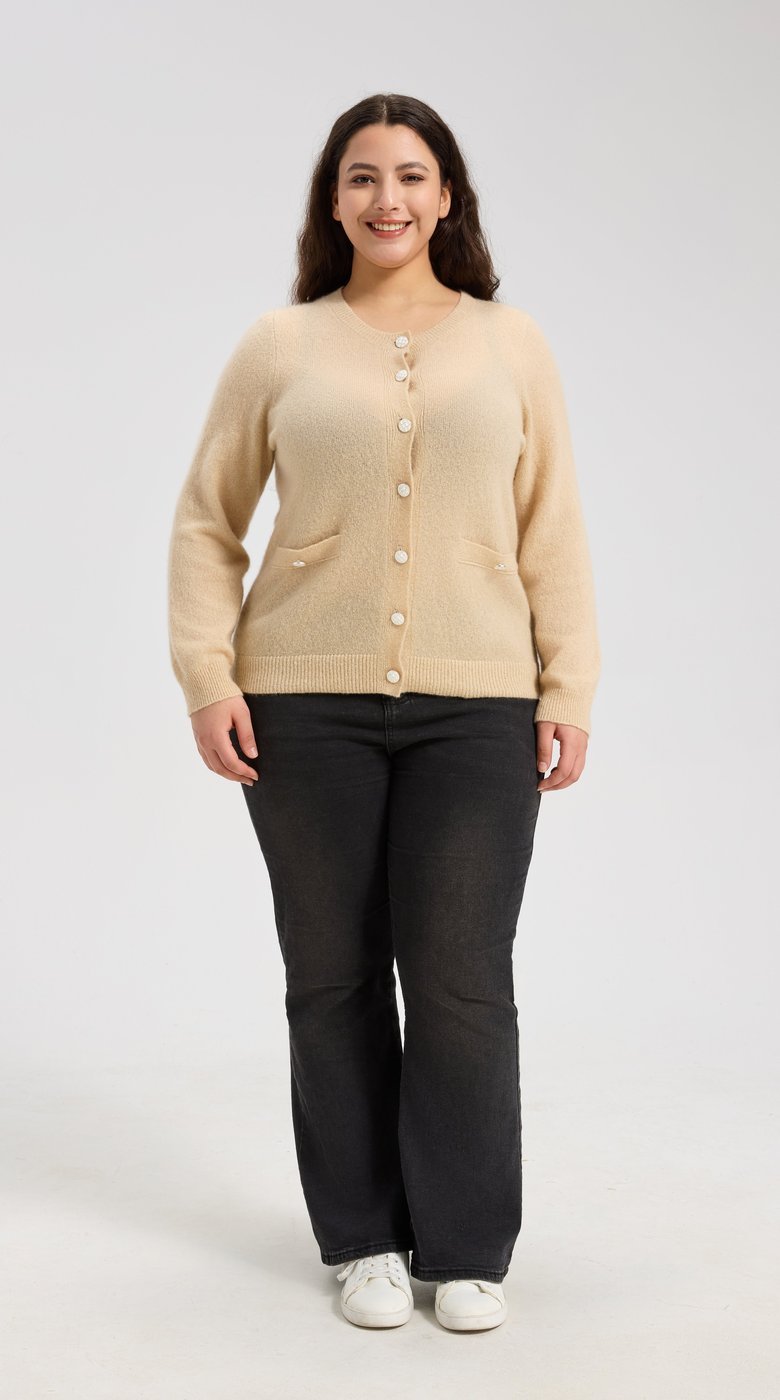
The silhouette the category is anchored on: a fine-gauge crew cardigan with a straight placket, shell buttons and set-in pockets. Cardigans are forecast at 6.0% compound annual growth to 2034, with fall/winter taking 60–65% of unit volume. See the current cashmere cardigan range.
2. The Cardigan-as-Blazer Move
The single most useful silhouette shift for a 2026 range is the knit blazer cardigan: a rib-bodied cardigan given a structured lapel, a double-breasted or wide placket, and enough body to hold a line across the shoulders. It occupies the register a tailored blazer used to own — sharper than a sweatshirt, less formal than a suit jacket — which is exactly the register that hybrid work schedules have normalised.
Commercially it does something a blazer cannot. It is unlined, so it packs flat, travels without creasing on a hanger it does not need, and works over a turtleneck, a shirt or a fine tee without the shoulder bulk. For a retailer it also behaves like knitwear on the shelf and like tailoring in the fitting room, which is a useful combination in a season where outerwear is the category being watched.
Construction points worth writing into the brief:
Element
What to specify
Why it decides the reorder
Lapel
Two-ply or heavier rib panel, pressed and seam-set, not steamed flat
A lapel that collapses after the first wash turns a blazer cardigan back into a cardigan
Placket
Double-breasted or invisible placket with reinforced button anchoring
Wide plackets show every waviness; invisible closures read sleekest
Shoulder
Set-in sleeve with a defined shoulder line, minimal padding
The shoulder carries the whole "structured" claim — rake or drop changes the look entirely
Body
Firmer yarn count so the front edge stands, hem rib with recovery
Firm bodies photograph as tailoring; soft bodies photograph as housewear
Fastenings
Shank-anchored buttons, spare button supplied, one button cycle tested
Button loss is the most common return reason on front-opening knitwear
The test to run before signing off is a wash-and-recover check on the sealed sample: five home washes, then measure lapel depth, front-edge straightness and hem recovery against the original. Ask for actual garment measurements of the sealed sample rather than the size chart, because rib panels relax differently across dye lots.
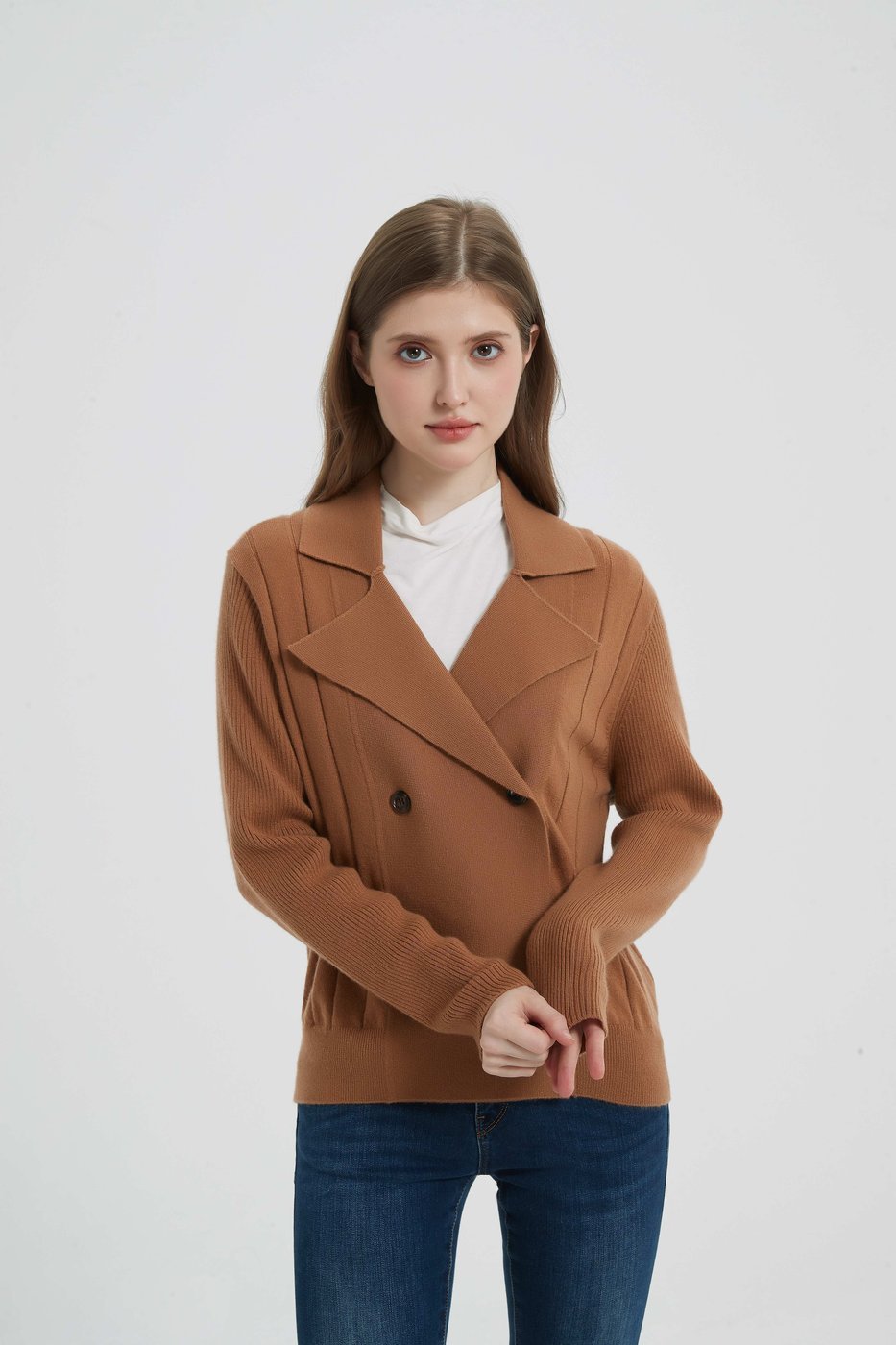
The cardigan-as-blazer construction: rib body, structured lapel, wide placket. This is the silhouette taking over the office layer — see the current knitted blazer cardigan.
3. Longline and the Coatigan: The Transitional Outerwear Play
Length is the second silhouette lever, and it is the one that moves a cardigan out of the knitwear department and into the outerwear conversation. Three bands are worth separating in a range plan:
Hip-length (55–70 cm): the classic axis. Layers under coats, carries the highest volume, safest repeat.
Longline (85–105 cm): covers the seat, opens over wide-leg trousers and skirts, works from September into April in most temperate markets.
Coatigan (110 cm and up): a genuine outerwear substitute for a city autumn. Needs weight and a firm hem or it will stretch at the pockets.
A longline cardigan is judged on weight distribution, not on softness. Four-ply or six-ply yarn, a 7-gauge body and roughly 900 g of yarn into the garment are the numbers that keep a long front edge from bowing. The split-hem detail seen across 2026 collections exists for the same reason — leaving the side seams open at the bottom lets the piece layer over wider trousers without pulling across the hip.
Failure modes to specify against: pocket bags that need reinforcement so they do not drag the front panel; button spacing that should tighten below the waist rather than stay even; and hem recovery tested after five washes, not after one. A longline cardigan that grows two centimetres on the hanger is a markdown, not a reorder.
4. Silhouette Map: Cropped, Half-Zip, Ribbed and Collared
Beyond the two hero silhouettes, four shapes are doing the volume work in 2026. Each one asks for a different gauge and a different finishing routine, which is why a range built on one gauge across all four tends to disappoint in at least two of them.
Silhouette
Length and gauge
What buyers get wrong
Cropped
45–52 cm back length, typically 12-gauge or finer
Built too soft, so it rides up over a high waist instead of sitting square
Half-zip / full-zip
7–12 gauge with a ribbed stand collar
Zip weight mismatched to yarn — a heavy zip pulls the placket into a wave
Ribbed collared
7-gauge waffle or rib, shirt-style collar
Collar knitted too loosely, so it flops instead of framing the neck
Textured / patterned
Jacquard or intarsia panel on a plain body
Pattern float tension left unspecified, so the panel shrinks in the wash
The zip styles deserve their own note because they are the fastest-growing men's shape in the category. A zip cardigan is judged mostly on three things: zip pull glide, placket stability after the zip is closed, and collar memory — the stand collar should return to shape after being folded in a suitcase. Specify the zip brand and weight in the tech pack rather than leaving it to the workshop's default stock.
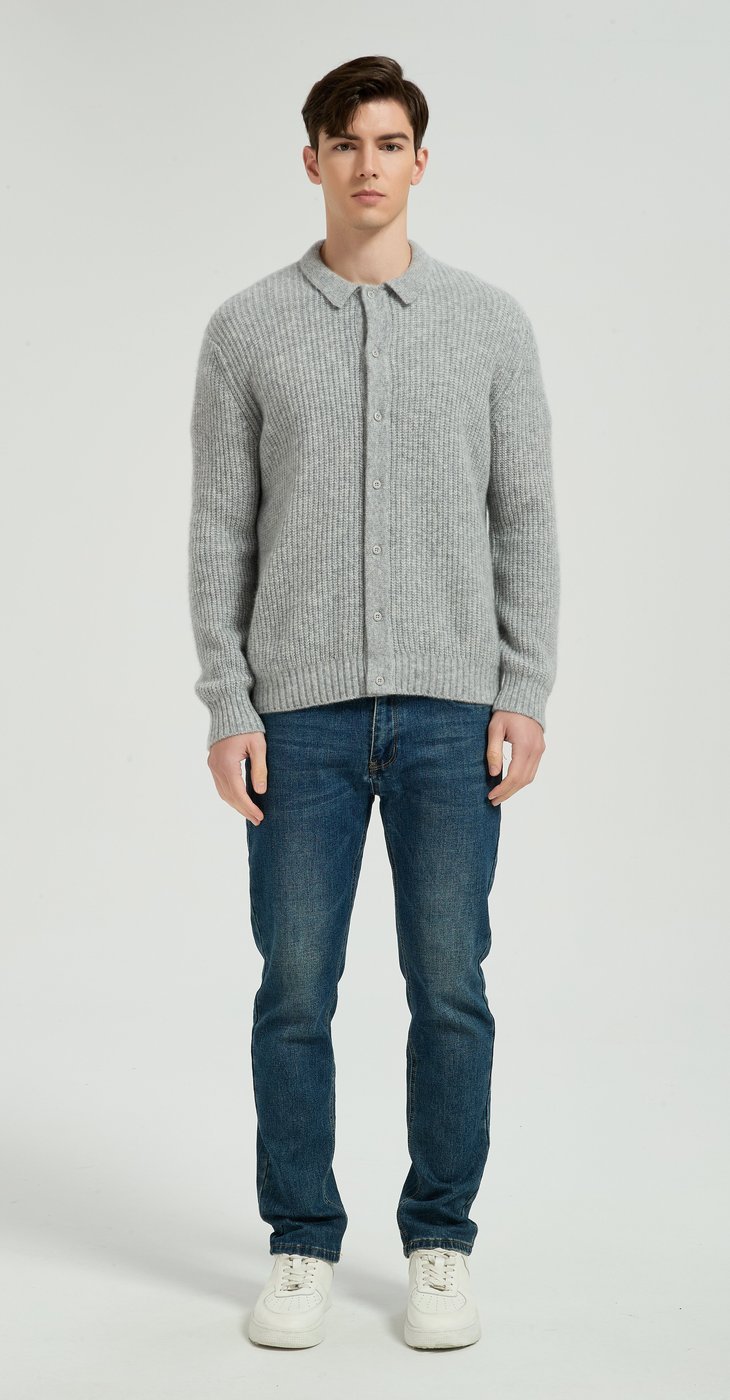
The ribbed collared cardigan reads like a shirt jacket and carries men's ranges in 2026. Collar density and sleeve rib depth are the two details that separate a sharp version from a shapeless one — see the waffle-knit collared cardigan.
5. The Spec Sheet Worth Signing Off Before Sampling
Cardigans fail in production for specification reasons rather than design reasons. The following sheet covers the items where a written number removes an argument later — and it doubles as the checklist for comparing two suppliers quoting what sounds like the same garment.
Item
Specification to state
Verification method
Fibre
Grade A cashmere, 14–15.5 microns, 34–36 mm staple
Independent composition and micron report per dye lot
Ply
2-ply for entry, 4-ply for the core tier, 6-ply for outerwear lengths
Yarn count certificate; 2-ply pills earlier under regular wear, 4-ply and above hold their surface for years
Gauge
12-gauge fine, 7-gauge chunky, 5-gauge heavy
Machine setting confirmed at development stage, not at bulk
Buttons and placket
Shell or resin buttons, shank-anchored, spare button, placket stays flat when closed
Button-pull test on three positions; placket measured for straightness
Colour matching
Tonal programmes within ΔE 1.0 across components
Spectrophotometer reading per component, approved at yarn stage
Surface performance
Anti-pilling finish; machine-washable finish where the programme needs it
Five-home-wash test, then rate pilling and re-measure the body
Legal labelling
Average fibre diameter of 19 microns or less to be labelled cashmere in the United States
Treat the legal limit as a floor, not a comfort target — the band above it is where the hand feel lives
Certification
Oeko-Tex Standard 100 for restricted substances; GCS for audited cashmere supply chains; GRS where recycled yarn is used
Current certificates per production site, requested at sampling
On the certification side, the standards that buyers are asked about most often are Oeko-Tex Standard 100 for chemical safety and the Good Cashmere Standard for animal welfare and farm-level traceability. Both are worth requesting at sampling stage rather than before shipping, because a certificate that arrives with the goods cannot change the yarn that was already knitted.
Functional finishing has moved from a premium request to a core specification in the same period: machine-washable finishing and anti-pilling treatment appear in the 2026 order books as standard rather than as an upgrade, largely because a cardigan that pills early generates returns while the identical silhouette with a surface treatment generates repeat orders.
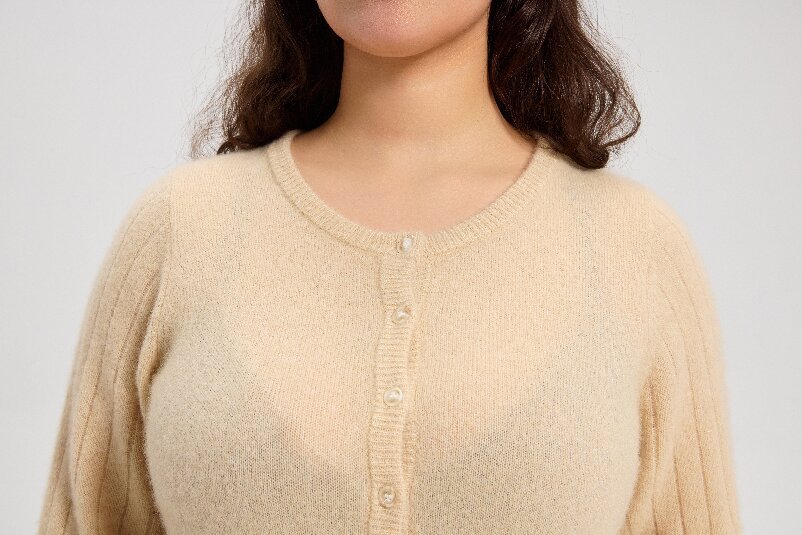
Neckline and placket close-up: the two places a cardigan is judged in the hand. Button spacing, placket rib width and collar roll are all decided here — and all measurable on the sealed sample.
6. The Men's Tier and the Buy Calendar Behind a Cardigan
Men's cardigans are the quiet volume story of the season. The shapes selling are specific — V-neck ribbed button-through, full-zip with a stand collar, collared waffle knits — and the difference between a men's cardigan that works and one that does not is mostly fit architecture rather than decoration. Men's bodies need a longer back length, a straighter rib, and a shoulder that sits where the shoulder is; waist shaping borrowed from a women's block is the most common reason a men's sample gets rejected on the floor.
The calendar is the part buyers underestimate, because a cardigan programme has two approval gates instead of one. When a programme is tonal — cardigan plus coordinating piece — colour has to be approved at the yarn stage, roughly two weeks before the garment sample is judged. Working back from a December selling peak:
Stage
Lead time
Why it is where it is
Yarn and colour approval
1–2 weeks before sampling
Tonal programmes cannot start sampling on an unapproved colourway
Sample development
7–10 days per round
Allow one revision round; lapel and longline samples usually need it
Bulk production
3–4 weeks
Rib panels and seam-setting are the slow steps, not the knitting
Inspection and freight
1–2 weeks
Booking space in advance now matters more than it did pre-2020
In practice that means a programme intended to be on the floor through December needs to be in production by late September. Anything starting in November lands after the set-buying window closes, which is the window that carries the strongest basket per customer.
For ranges built around the same fibre supply, the men's knitwear collection covers the V-neck and zip shapes, the kids knitwear collection takes the family extension, and the accessories range completes a gift-oriented programme.
7. Wholesale Cashmere Cardigan FAQ
Q1. Which gauge should a cardigan programme start with?
Twelve-gauge for anything meant to layer under a coat, 7-gauge for the chunky silhouettes, 5-gauge for heavy outerwear-length pieces. Keep to one gauge per production line if you can: a range that spreads across three gauges needs three machine settings, three lead times and three sampling calendars.
Q2. Is the cardigan a two-season or a year-round product?
Both, in different constructions. Fall and winter take an estimated 60–65% of annual unit volume in cashmere, wool and blends, while spring and summer take 35–40% in cotton, linen, modal and viscose. In markets with heavy air conditioning, lightweight cardigans sell through the year.
Q3. Is a knit blazer cardigan genuinely office appropriate?
In creative offices, smart-casual and most professional-services environments, yes — a fine-gauge or rib-bodied cardigan with a defined shoulder reads sharper than a sweatshirt and less formal than tailoring. For traditional finance and legal settings a structured jacket is still the safer choice. Verify lapel recovery and shoulder line on the sealed sample before committing a range to the silhouette.
Q4. What causes pilling on a cashmere cardigan, and how do I reduce it?
Short fibre and low ply are the main causes, aggravated by friction at the underarm, cuff and where a bag strap crosses the body. Specify a minimum staple length, move the core tier to 4-ply or heavier, and request an anti-pilling finish with a five-home-wash test as the acceptance criterion.
Q5. What is a realistic development timeline for a tonal cardigan programme?
Allow one to two weeks for yarn and colour approval, seven to ten days per sampling round with one revision held in reserve, three to four weeks for bulk, and one to two weeks for inspection and freight. A programme landing on the floor for a December peak needs to be in production by late September.
Q6. Where can I see the cardigan constructions currently in production?
The cashmere cardigan range shows the blazer, longline, cropped and zipped constructions across women's, men's and kids' blocks, and the 2026 collection shows how the cardigan programmes sit alongside the rest of the knitwear range. Sample development starts from a brief.